Roles of Medical Billers vs Medical Coders: What Every Healthcare Provider Should Know

John Doe
Every time a patient walks out of a clinic, a sophisticated financial workflow kicks into action behind the scenes. Two professionals sit at the heart of this process: the medical biller and the medical coder. While these roles are often mentioned together and sometimes confused with one another, they serve very different functions within a healthcare practice.
Understanding the distinction between these two positions is not just an academic exercise. For practice managers, physicians, and healthcare administrators, knowing who does what can directly affect claim accuracy, reimbursement timelines, and the overall financial health of a practice. This guide breaks down both roles clearly so you can make smarter decisions about your staffing and medical billing operations.
What Does a Medical Coder Do?
A medical coder is essentially a clinical translator. After a patient visit, the coder reviews the physician’s documentation, including notes, diagnoses, lab orders, and treatment plans, and converts all of that clinical information into standardized alphanumeric codes.
These codes come from three primary systems used in the United States:
ICD-10-CM (International Classification of Diseases, 10th Revision) covers diagnoses and conditions. CPT (Current Procedural Terminology) codes describe medical, surgical, and diagnostic procedures. HCPCS Level II codes cover supplies, equipment, and services not included in CPT.
The coder must understand medical terminology, anatomy, physiology, and payer guidelines deeply enough to assign the most specific and accurate code for every documented service. A single wrong code can result in a denied claim, an audit, or even a compliance violation. This is why our professional medical coding services rely on certified specialists who stay current with annual code updates from CMS and the AMA.
Core Responsibilities of a Medical Coder
Chart Review Analyzing physician notes, operative reports, and lab results to extract billable data. | Code Assignment Assigning ICD-10, CPT, and HCPCS codes that precisely reflect the documented encounter. |
Compliance Monitoring Ensuring coding adheres to payer guidelines, CMS rules, and HIPAA requirements. | Querying Physicians Requesting clarification from providers when documentation is incomplete or ambiguous. |
What Does a Medical Biller Do?
Once the coder hands off a coded encounter, the medical biller steps in. The biller takes those codes and transforms them into a claim that can be submitted to an insurance payer or presented to a patient for payment.
A medical biller is responsible for the entire financial journey of a claim, from creation and submission all the way through collections. This includes verifying patient insurance eligibility, applying correct modifiers, submitting claims through electronic clearinghouses, tracking claim status, appealing denials, and posting payments.
Think of the biller as the advocate for your practice’s revenue. When a payer rejects a claim, the biller investigates the reason, corrects the error, and resubmits. Without a skilled biller, even perfectly coded claims can sit unpaid for months.
Core Responsibilities of a Medical Biller
Claim Submission Preparing and transmitting electronic claims (837P, 837I) to payers via clearinghouses. | Eligibility Verification Confirming patient insurance coverage and benefits before and at the time of service. |
Denial Management Identifying root causes of denied claims, correcting errors, and filing timely appeals. | Payment Posting Reconciling remittance advice (EOBs and ERAs) and posting payments accurately to accounts. |
Medical Biller vs Medical Coder: Side-by-Side Comparison
Category | Medical Coder | Medical Biller |
Primary Function | Translates clinical docs into standardized codes | Submits coded claims and manages payment collection |
Main Tools | ICD-10-CM, CPT, HCPCS, encoder software | Practice management software, clearinghouses, ERAs/EOBs |
Key Interaction | Works closely with physicians and clinical staff | Works closely with insurance payers and patients |
Top Certification | CPC (AAPC), CCS (AHIMA) | CBCS (NHA), CPB (AAPC) |
Primary Concern | Code accuracy and compliance | Timely reimbursement and accounts receivable |
Revenue Impact | Prevents undercoding, overcoding, and denials at source | Reduces A/R days and maximizes collections |
Workflow Position | Upstream (after clinical encounter) | Downstream (after coding is complete) |
How Both Roles Work Together in the Revenue Cycle
Medical billers and coders do not operate in silos. They are two gears in the same machine that is the healthcare revenue cycle. When both roles perform at a high level and communicate effectively, the results are fewer denied claims, faster reimbursements, and a healthier bottom line for the practice.
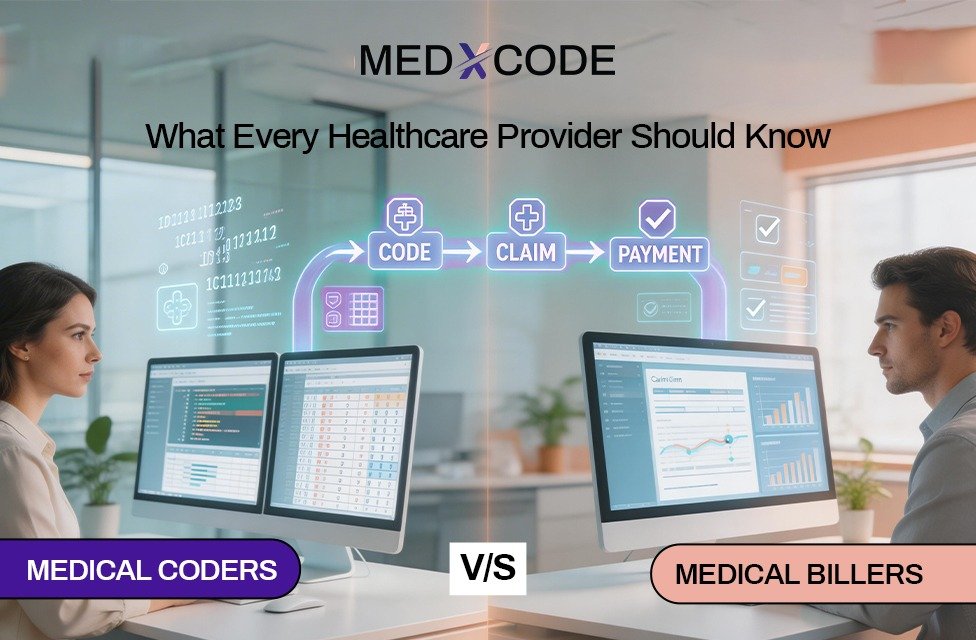
The typical flow goes like this: A patient receives care. The physician documents the encounter. The coder reviews that documentation and assigns codes. The biller takes those codes, verifies eligibility, builds the claim, and submits it to the payer. The payer adjudicates the claim and sends a remittance. The biller posts the payment or initiates an appeal if the claim is denied.
Did You Know? Claim denial rates average between 5% and 10% across most practices. The vast majority of denials are preventable and trace back to errors in either coding or billing. A coordinated team approach reduces this significantly. |
When there is a disconnect between these two roles, whether due to poor documentation, miscommunication, or inadequate training, revenue leakage occurs. This is one reason why many practices are turning to integrated revenue cycle management solutions that bring billing and coding under one roof with built-in quality checks.
Skills and Qualifications That Set Each Role Apart
While both roles require a foundational understanding of medical terminology and healthcare reimbursement, the skill sets diverge significantly at the professional level.
A strong medical coder needs exceptional attention to detail, comfort with clinical language, deep knowledge of anatomy and pathophysiology, and the analytical ability to read between the lines of physician documentation. Coders typically pursue credentialing through AAPC (CPC) or AHIMA (CCS, CCA) and must complete continuing education each year to maintain their credentials as code sets are updated annually.
A strong medical biller excels in communication, problem-solving, and persistence. They must navigate payer portals, interpret EOBs and ERAs, manage patient accounts, and understand the legal and contractual nuances of payer contracts. Billers often hold certifications such as the Certified Professional Biller (CPB) from AAPC or CBCS from NHA.
In smaller practices, you may find one person wearing both hats. In larger organizations, these roles are clearly separated to allow specialization and to maintain compliance. Regardless of practice size, the quality of both functions directly affects how much and how quickly your organization gets paid.
Why Outsourcing Both Functions Can Be a Smart Strategy
Many practices today are choosing to outsource their billing and coding functions to specialized companies rather than managing them in-house. The rationale is straightforward: maintaining a team of certified billers and coders internally requires significant investment in salaries, training, software, compliance oversight, and staff turnover management.
Outsourcing to a trusted partner like MedXCode gives practices access to an entire team of credentialed professionals across both disciplines, working within a technology-driven infrastructure designed for accuracy and speed. Practices that partner with MedXCode benefit from lower denial rates, reduced accounts receivable days, and the confidence that comes from knowing their revenue cycle is handled by specialists.
Final Thoughts
Medical billers and medical coders are not interchangeable, but they are equally indispensable. The coder ensures that every service rendered is translated into the right code with precision and compliance. The biller ensures that coded encounter turns into actual revenue through skilled claim submission, follow-up, and collections management.
Whether your practice handles these functions in-house or partners with an external team, understanding the distinct value each role brings is the first step toward a stronger, more resilient revenue cycle. When both positions are staffed correctly and communication between them is seamless, the financial performance of your practice reflects it.
Frequently Asked Questions
1. What is the main difference between a medical biller and a medical coder?
A medical coder translates clinical documentation into standardized codes (ICD-10, CPT, HCPCS), while a medical biller uses those codes to create and submit insurance claims and collect payment from payers and patients. Both roles are essential, but they operate at different stages of the revenue cycle.
2. Can one person handle both medical billing and medical coding?
Yes, particularly in smaller practices where resources are limited. However, combining both roles in one person can increase the risk of errors and compliance gaps. Larger organizations typically separate the two functions to allow for specialization and dedicated quality oversight.
3. Which certification is needed for each role?
For medical coding, the most recognized credentials are the CPC from AAPC and the CCS from AHIMA. For medical billing, the CPB from AAPC and the CBCS from NHA are widely recognized by employers and payers.
4. How do medical billers and coders impact revenue cycle management?
Both roles are essential pillars of revenue cycle management. Accurate coding reduces claim denials at the source, while effective billing ensures timely reimbursements and healthier cash flow. A gap in either area can lead to increased denial rates, delayed payments, and revenue leakage that compounds over time.
5. Should my practice outsource medical billing and coding?
Outsourcing to a specialized provider like MedXCode allows practices to access certified professionals, reduce overhead costs, lower denial rates, and redirect staff time toward patient care. It is particularly beneficial for practices that struggle with claim denials, slow accounts receivable, or staff turnover in their billing department.
Ready to Streamline Your Billing and Coding?
MedXCode’s certified team reduces your denial rate, accelerates reimbursements, and protects your revenue starting at just 3.99% of monthly collections.