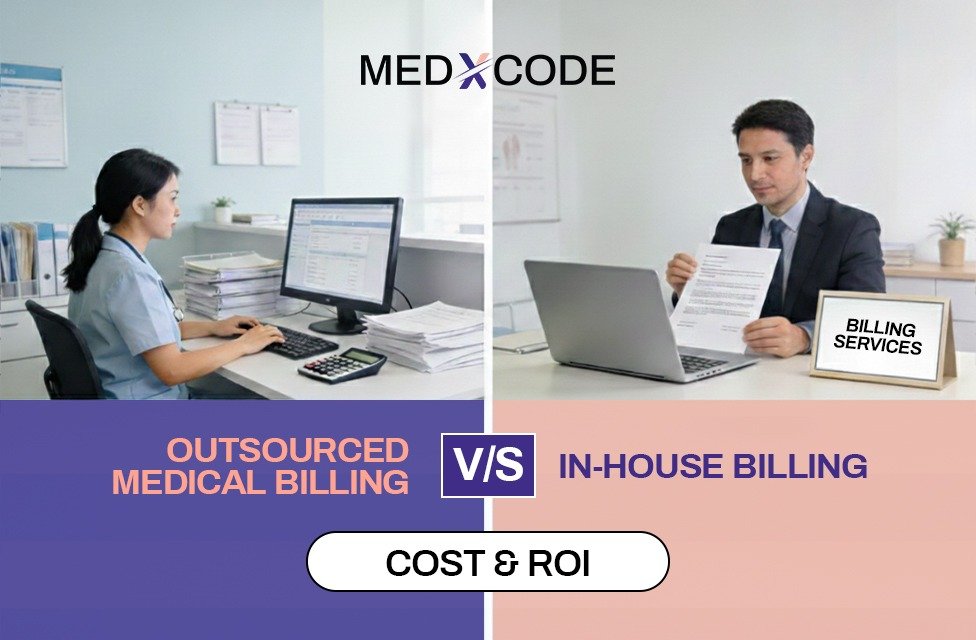
Outsourced Medical Billing Vs In-House Billing: Cost, ROI, and What Actually Matters

John Doe
Let’s be honest most practices don’t think about billing strategy until something breaks.
Cash flow slows down. Claims start piling up. Staff get overwhelmed. Or worse revenue quietly leaks month after month, and no one notices until it becomes a real problem.
At some point, almost every clinic asks the same question:
Should we keep billing in-house, or hand it off to an outside team?
On paper, in-house billing can look cheaper. It feels more “under your control.” But once you step back and look at the real costs not just salaries, but lost revenue, inefficiencies, denials, and staff burnout the decision becomes a lot more complex.
This isn’t a sales pitch. It’s a realistic breakdown of how both models actually perform in the real world. For small practices, outsourcing often improves operational efficiency.
The Real Cost of Keeping Billing In-House
Most practices underestimate what internal medicine billing really costs.
Sure, you pay a staff member’s salary. But that’s just the surface.
There’s also:
- Hiring time (and rehiring when someone quits)
- Training and retraining when codes and payer rules change
- Software licenses and clearinghouse fees
- Time lost when staff multitask or fall behind
- Claims that get delayed because no one had time to follow up
- Revenue that quietly disappears due to missed or under coded charges
And then there’s the hidden cost nobody tracks:
Doctors and office managers spending mental energy fixing billing problems instead of focusing on patients or growth.
That cost doesn’t show up on a spreadsheet but it adds up fast.
Why Outsourced Billing Often Feels Like a Relief
When practices outsource, it’s usually not because they want less control.
It’s because they want less chaos.
A dedicated external billing team usually means:
- Claims get submitted faster
- Denials get worked more consistently
- Follow-ups don’t depend on one busy staff member
- Coding accuracy improves over time
- Revenue tracking becomes clearer and more predictable
Instead of billing being something you “hope is working,” it becomes a system that actually runs in the background.
For many clinics, that shift alone is worth it even before looking at ROI.
ROI Isn’t Just About Cost — It’s About Money You Didn’t Know You Were Losing
Here’s something most practice owners don’t realize until they audit their billing:
They weren’t collecting everything they should have been.
Not because of fraud. Not because of negligence.
But because of:
- Undercoding
- Missed secondary claims
- Denials that never got appealed
- Claims that aged out
- Small balances that nobody had time to chase
Outsourced teams tend to recover money that internal teams simply didn’t have time to track.
So even if outsourcing costs more on paper — the net revenue often increases.
That’s the real ROI conversation.
Workflow Reality: What Actually Changes Day to Day
When Billing Stays In-House
Things usually depend on one or two key people.
If they’re out sick, on vacation, or overloaded — billing slows down.
Follow-ups get delayed.
Denials sit longer than they should.
Staff feel pressure from both patients and insurance companies.
It works… until it doesn’t.
When Billing Is Outsourced
Work becomes more predictable.
Claims move on schedule.
Someone is always watching aging reports.
Denials don’t sit untouched.
Front-desk staff feel less pressure.
Doctors get fewer interruptions about billing issues.
It doesn’t make a practice perfect — but it reduces daily friction
Compliance and Errors: A Quiet Revenue Killer
One small coding mistake can delay payment for weeks.
A pattern of errors can lead to audits.
Outdated payer rules can result in avoidable denials.
Internal teams try to stay updated — but billing rules change constantly.
External billing specialists usually track:
- Coding updates
- Payer policy changes
- Documentation requirements
- Denial patterns
Not because they’re smarter — but because that’s their only job.
That focus often translates into cleaner claims and fewer avoidable losses.
A Realistic Scenario (Not a Fairytale Case Study)
A mid-sized clinic once assumed their billing was “fine.”
They weren’t in crisis.
They weren’t losing money visibly.
But after switching to outsourced billing, they noticed:
- Denials dropped
- Old unpaid claims started getting recovered
- Monthly collections stabilized
- Staff stress dropped
- Doctors stopped getting pulled into billing issues
Nothing dramatic. No overnight miracle.
Just steadier revenue and fewer headaches.
That’s usually how real improvement looks.
Where MedxCode Fits Into This Picture
MedxCode isn’t just about submitting claims — the focus is on cleaner workflows, tighter follow-ups, and more predictable revenue.
What makes a difference in practice:
- Adjusting workflows, not forcing generic systems
- Understanding payer behavior instead of guessing
- Tracking performance so revenue problems don’t stay hidden
- Scaling billing capacity without forcing practices to hire more staff
It’s less about “outsourcing work” and more about reducing financial blind spots.
If a practice wants to explore a more stable billing setup, learning how MedxCode handles billing operations can be a practical step — without pressure.
The Honest Truth: When In-House Still Makes Sense
Outsourcing isn’t always the right answer.
In-house billing can work well if:
- The team is experienced and stable
- Claim volume is low
- Denial rates are already under control
- Revenue tracking is clean and consistent
Some practices do fine internally.
The key is knowing whether your current system is actually performing — or just “getting by.”
When Outsourcing Becomes the Smarter Move
It’s usually time to rethink billing if:
- Claims are aging longer than they should
- Staff feel constantly behind
- Denials are creeping up
- Revenue feels inconsistent month to month
- Growth feels limited by admin workload
In those situations, outsourcing isn’t a luxury — it’s often a financial reset.
Frequently Asked Questions
Is outsourcing billing more expensive than keeping it in-house?
Not necessarily. When factoring in payroll, software, training, and recovered revenue, outsourcing often delivers better financial value.
How quickly can a practice see ROI after outsourcing?
Many practices notice improved collections and faster reimbursements within 2–4 months.
Does outsourcing reduce control over financial data?
Reputable billing partners provide transparent reporting and full revenue visibility.
Can outsourced billing handle specialty practices?
Yes. Experienced billing providers support a wide range of specialties and payer requirements.
Will outsourcing reduce staff workload?
Yes. Staff can focus more on patient care and front-desk efficiency instead of claim management.
Is outsourcing secure and compliant?
Professional billing companies follow strict HIPAA and data security standards.